
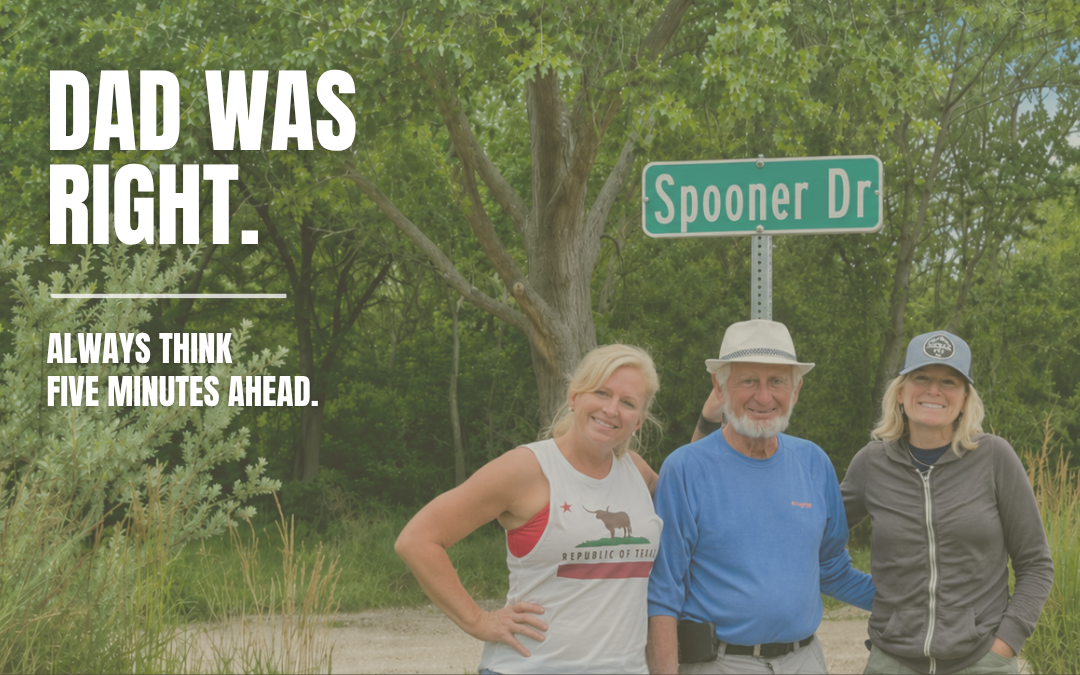
In live events, anticipation is part of the job.
Long before I ever worked backstage, my dad was teaching me how to work.
He had a few sayings we heard over and over growing up:
“If you’re five minutes early, you’re on time. If you’re on time, you’re late.”
And:
“Look around the room and see what needs to be done. Then do it.”
My dad spent years as a lineman building highline towers. The work was hard, and much like freelancing today, your reputation mattered. You did a great job because that’s how you got called for the next one.
He eventually became a successful business owner, running his own welding shop building hitches and wrought iron. The work changed, but his philosophy never did.
Show up early. Pay attention. Don’t wait to be told everything that needs to happen.
I didn’t know it then, but he was teaching me the Five-Minute-Ahead Mindset.
And it turns out that mindset works pretty well backstage, too.
There’s something your favorite event professionals have in common.
They’re rarely thinking only about what’s happening right now. They’re thinking about what happens five minutes from now.
Who’s next? What’s changing? Who needs help? Who is running late? What could become a problem if nobody catches it?
Over the years, I’ve learned that this ability to anticipate is one of the biggest differences between someone who does their job well and someone you immediately want on your next show.
Doing Your Job Is the Starting Point
Every position on a production has a purpose, and understanding who owns what is where good teamwork starts.
The A2 gets presenters mic’d and ready. The Deck Manager owns what’s happening backstage and on the deck. The Stage Manager manages timing and cues. Graphics keeps presentation content moving. Producers keep information, schedules and logistics organized.
Knowing what you own matters.
But strong event professionals don’t put blinders on while they’re doing it.
An A2 is mic’ing one presenter while already looking for the next.
A Deck Manager is watching the person onstage while making sure the next presenter is backstage, the furniture move is ready and the exit path is clear.
A Graphics Operator isn’t only looking at the slide currently on screen. They’re listening to the presenter and looking ahead in the deck.
A Producer isn’t waiting for someone to ask whether the show flow or script changed. They’re making sure the right people already have the newest versions.
It’s not about doing more jobs.
It’s about seeing more of the show.
Learn to Read the Room
Some of this comes with experience.
After enough shows, you start recognizing the little signals.
A presenter walks backstage and looks nervous.
Someone from the client team suddenly starts looking around for the Producer.
A rehearsal is running long.
The next panel hasn’t arrived.
Someone quietly says, “Did anybody tell audio about that?”
None of those things necessarily mean there’s a problem.
Yet.
Experienced event professionals learn to notice those moments and ask the right question before a small issue becomes a show problem.
Sometimes the answer is simply, “Yep, we’ve got it.”
Great. Keep moving.
Other times, that one question catches something everyone else assumed someone had handled.
Five Minutes Ahead, Not Five Departments Over
There is an important distinction here.
Being proactive does not mean taking over someone else’s job. Having the right people in the right roles still matters.
In fact, some of the biggest problems backstage happen when people start making decisions outside their lane.
Good teamwork means knowing the difference between noticing something and owning something.
If you see a problem coming, communicate it to the person who owns it. Offer help. Share information. Ask the question.
Then let people do the jobs they were hired to do.
That combination of awareness and respect is what makes a crew work.
The People You Want Back
When a show ends, we tend to remember the big saves. The impossible turnaround. The last-minute solution. The person who stepped in when something went sideways.
But some of the most valuable work on a show is much quieter.
It’s the problem that never happened.
The presenter who was found before anyone had to ask.
The updated deck that was already loaded.
The chair that was moved before rehearsal instead of during it.
The question that got asked ten minutes before it became an emergency.
My dad had one more saying:
“Always do more than your share.”
I’ve carried that one with me my entire career.
It doesn’t mean doing someone else’s job or needing to be the hero. It means paying attention. Being prepared. Helping when help is needed. Taking responsibility for what you bring to the team.
My dad never worked in live events, but he taught me a lot about how to succeed in them.
Show up early.
Look around.
See what needs to be done.
And always do more than your share.
Turns out, Dad was teaching me to think five minutes ahead all along.
Happy Birthday, Dad! This blog’s for you. ❤️