
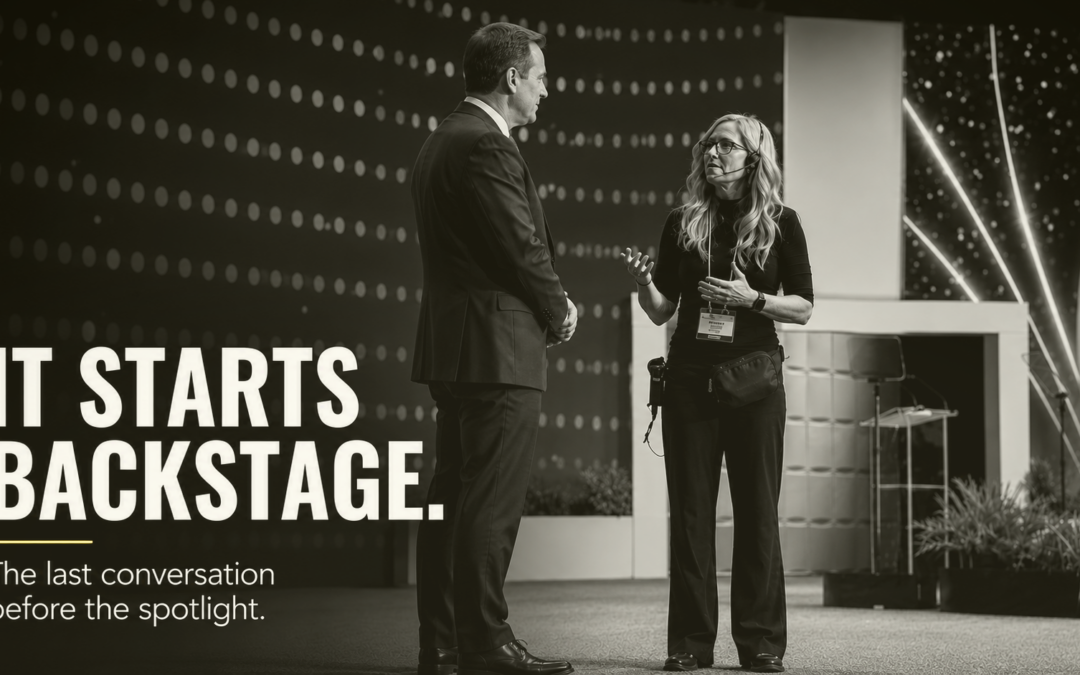
Lessons Learned from Three Decades on the Deck
Share this blog
When I’m interviewing someone for a Deck Manager position, I always ask the same question.
“Who approves the furniture placement on stage?”
The answers are almost always the same.
“The Producer.”
“The Creative Director.”
“The client.”
All reasonable answers.
Most people answer confidently.
And that’s exactly what makes this such a good interview question.
Before a single chair, podium, or table is moved, I can think of three people who need to agree: the Producer, the Video Director, and the Lighting Director.
Notice I didn’t say the Deck Manager.
Why?
Because moving a chair isn’t just moving a chair.
It changes camera framing. It changes lighting focus. It affects where a presenter stands, where they look, and how the audience experiences the presentation. Once everyone agrees, the furniture is spiked so it returns to the exact same location after every rehearsal, reset, or cleaning break.
That one interview question tells me a lot.
Not because furniture is important.
Because it tells me whether someone understands one of the biggest truths in live events.
Everything backstage and onstage affects someone else.
That’s what great Deck Managers understand.
More Than a Different Title
Depending on the production company, this role may be called a Deck Manager, Assistant Stage Manager (ASM), or Backstage Manager.
The title changes.
The mission doesn’t.
A great Deck Manager creates an environment where presenters can do their very best work.
That means coordinating rehearsals, supporting speakers, communicating with the production team, anticipating problems before they happen, and making sure every presenter walks onstage feeling prepared and confident.
Unfortunately, it’s also one of the first roles cut when budgets get tight. Some productions assume the Producer or Stage Manager can simply absorb the responsibilities.
Sometimes they can.
More often, they’re already focused on their own critical roles.
A dedicated Deck Manager allows everyone else to do their jobs better while creating an exceptional experience for the presenters.
Own the Stage
One of the first things I tell a new Deck Manager is simple:
“Own the stage. It’s your domain.”
That doesn’t mean making every decision.
It means taking responsibility for everything happening in your world.
You know where every presenter is.
You know who’s next.
You know who’s still in makeup.
You know if the clicker is working.
You know if someone accidentally moved a chair after it was spiked.
You know if the backstage environment is calm, organized, and ready for the next speaker.
Because once the show starts, nobody should be asking,
“Where’s our next speaker?”
The Deck Manager should already know.
Owning the stage isn’t about authority.
It’s about responsibility.
It also means owning the presenter experience.
If a presenter is confused…
That’s your problem.
If their mic is falling off…
That’s your problem.
If they walk onstage without a clicker…
That’s your problem.
Not because you caused it.
Because you’re the person best positioned to solve it.
Great Deck Managers Think Ahead
The best Deck Managers are always living five minutes in the future.
Who’s arriving next?
Who’s running late?
Who just walked into the green room?
Has the rehearsal order changed?
Does the Show Caller need a few more minutes to line up cues?
Has Audio finished mic’ing the next presenter?
Does the next presenter know where they’re entering?
Do they know where to stand?
Are the DSMs (confidence monitors) visible from every angle they’ll need them?
Will the VOG introduce the presenter, or will they be revealed after the opening video?
Most importantly…
What does the next presenter need from me before they walk onstage?
Great Deck Managers don’t wait for problems to appear.
They’re already solving the next one before anyone else realizes it’s coming.
That’s not luck.
It’s judgment.
And judgment is earned one show at a time.
Great Rehearsals Don’t Just Happen
One of the biggest misconceptions about this role is that rehearsals somehow run themselves.
They don’t.
In fact, running rehearsals is one of my favorite parts of being a Deck Manager.
Before presenters ever arrive, the production team should understand the room. Reviewing room drawings, walking through the Run of Show with the Producer and Stage Manager, and conducting a technical rehearsal with the whole team without the client present gives everyone an opportunity to align before the pressure of live rehearsals begins.
Once presenters arrive, everything changes.
The Producer is often focused on the client and the content.
The Stage Manager is building cues and preparing to call the show.
That’s when the Deck Manager shifts into another role—owning the presenter experience.
We greet presenters, answer questions, coordinate with the A2 to get microphones on, walk them through entrances and exits, explain the DSMs, speaker timer, teleprompter, and clicker, and make sure they understand exactly what will happen before they ever step onstage. We make sure the stagehands are at the ready for furniture moves.
The Deck Manager is in constant communication with the Stage Manager, making sure they have the information they need to keep rehearsals moving. It’s a partnership, and when both roles are working together, rehearsals feel organized, efficient, and surprisingly calm.
When rehearsals feel calm, presenters feel confident.
And confident presenters give better presentations.
Read the Room
The best Deck Managers also have exceptional emotional intelligence.
Every presenter arrives backstage carrying something different.
Some have delivered hundreds of keynote presentations.
Others are stepping onto a stage for the very first time.
Some need complete silence before they begin.
Some want to rehearse one more time.
Some need someone to say,
“You’ve got this.”
Some want a high five.
I’ve even had presenters ask if we could pause for a quick prayer before they walked onstage.
I’ve also learned that some presenters simply need a quiet place to think.
On several productions, I’ve created a small backstage workspace for my lead presenters. Nothing fancy. A table, power for their laptop, good lighting, tissues, water, and a quiet place to review their notes. Close to the stage, not tucked away in the green room.
I have given them a place to think, prepare, and take a breath before they hit the stage.
Sometimes the best thing a Deck Manager can do is create a little calm in the middle of the chaos.
To me, that’s part of owning the presenter experience.
Those small details build trust.
They reduce anxiety.
And they allow presenters to focus on their message instead of everything happening around them.
Every one of those moments requires something different.
A great Deck Manager reads the room.
They know when to talk.
They know when to stay quiet.
They know when confidence needs to be built.
And they know when confidence simply needs to be protected.
You don’t learn that from a checklist.
You learn it by genuinely caring about the people you’re supporting.
Communication Is the Job
People often think Deck Managers spend their day escorting presenters.
In reality, they’re communicating.
I’ve always believed a Deck Manager owns the presenter experience.
We become the bridge between the presenter and the production team, making sure the right information reaches the right people at the right time.
We remove uncertainty.
We build confidence.
We help presenters focus on their message instead of the mechanics of the show.
Because when communication breaks down, productions break down.
The Compliment I’ll Never Forget
I’ve been fortunate to work with incredible presenters throughout my career.
One compliment has stayed with me.
After a corporate event, the Vice President of Sales handed me a handwritten note before leaving.
He thanked me for helping him through the event and called me “the lynchpin of the production.”
I still have that note.
Not because it complimented me.
Because it reminded me what this role is really about.
He remembered how he felt.
Prepared.
Supported.
Confident.
I don’t remember every compliment I’ve received.
I remember that one.
Final Thoughts
I’ve spent more than 30 years backstage.
I’ve produced shows, called cues, and managed decks for everything from corporate conferences to major sporting events.
If there’s one lesson I’ve learned, it’s this:
Great Deck Managers don’t measure success by how many cues they have executed, how many rehearsals they run, or how many problems they solve.
They measure success by how prepared the presenter feels when it’s time to step onstage.
Because when presenters feel prepared…
They’re free to focus on delivering their message.
And if someone leaves you a handwritten note calling you “the lynchpin of the production,” you’ll know it was never about being the center of attention.
It was about helping someone else succeed.
After three decades on the deck, I still believe that’s one of the most rewarding jobs in live events.
Author Bio
Nancy Spooner is the Founder & CEO of Tempo Live Events. With more than 30 years of experience as a Producer, Show Caller, and Deck Manager, she has supported presenters at corporate events, major sporting events, and live broadcasts across North America. Nancy is passionate about mentoring the next generation of live event professionals and creating exceptional experiences for presenters both onstage and backstage.
Continue the Conversation
Interested in learning more about backstage roles or joining the Tempo community?
- Explore our Roles & Responsibilities Guide
- Learn more about Tempo’s staffing services
- Join the Tempo Freelancer Community