
Share this blog
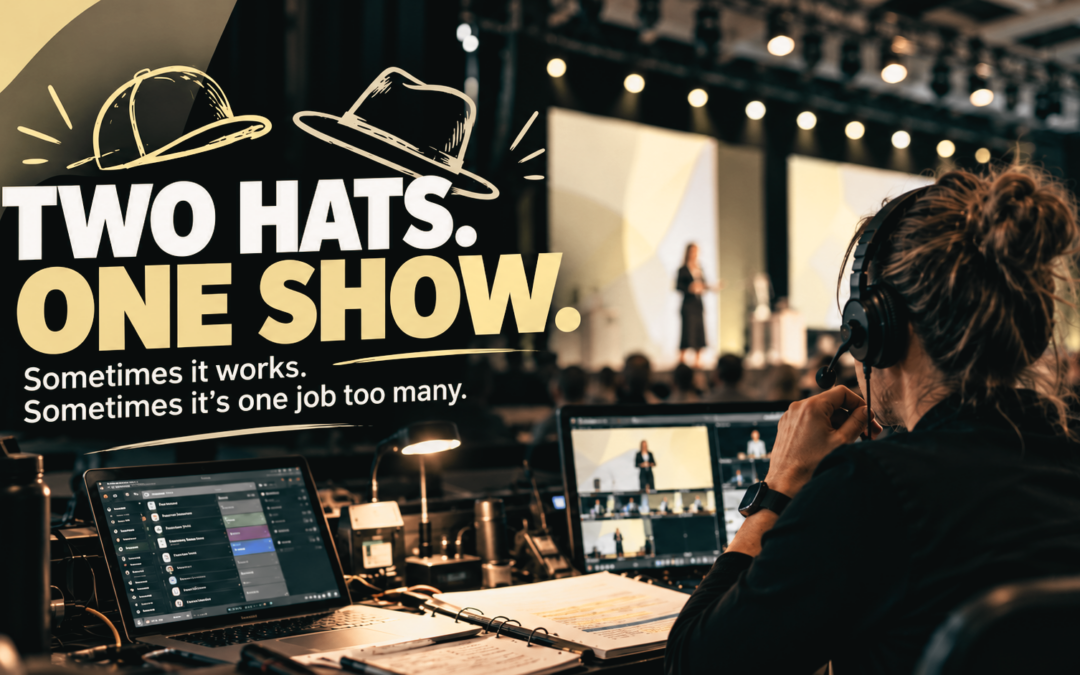
When combining event roles works, and when one person is being asked to do too much.
I’ve worked shows where I’m on a wireless intercom, calling cues while also managing the deck, running rehearsal, making sure presenters hit their marks and getting everyone where they need to be. On the right show, I can comfortably do both.
I’ve also called shows where I am firmly planted in my seat at front of house, calling intricate sequences of lighting, audio, video, graphics and entertainment cues. On those shows, there is absolutely no way I could also be backstage managing presenters.
Same person. Same skill set. Very different show.
That is the thing about combining roles in live events. Sometimes it makes perfect sense.
Every production role has its own lane, even though there is often some overlap (here’s how we define some of the most common live event roles).
A Graphics Op may also run video playback. A Show Caller in a small room may run a simple lighting package with a stage wash and a couple of walk-in and walk-out looks. An A2 may manage the stage/deck. A TD may also call the show.
None of those combinations are automatically wrong.
In fact, on the right show, they can be smart, efficient staffing decisions.
The real question is not:
Can this person do both jobs?
It is:
Will the show require them to do both jobs at the same time?
When Combining Roles Works
Smaller shows do not always need a person sitting in every possible seat.
If a Graphics Operator is already managing presentation content and the video playback is straightforward, adding playback to that position might be completely reasonable.
If the lighting in a small breakout consists of a stage wash and a couple of simple looks, a Show Caller who knows the system may be able to run those cues without missing a beat.
An A2 might successfully manage microphones and the deck when there are only a handful of presenters and backstage movement is simple.
And on plenty of shows, the TD may also serve as the Show Caller. If the technical systems are stable, the cueing is manageable and the TD has the bandwidth to keep an eye on the bigger technical picture while calling the show, that combination can work really well.
Those are not shortcuts. They are examples of matching the crew to the actual needs of the production.
Then the Show Gets Bigger
The problem starts when responsibilities that looked compatible on paper begin competing for attention.
Now the A2 has six presenters who need microphones while furniture has to move onstage and the next speaker cannot be found.
The Graphics Op is taking last-minute slide changes while also trying to roll a series of tightly cued videos.
The TD is calling the show when suddenly a technical issue needs their full attention. The next cue is still coming, but the technical team is also looking to them for a solution.
Or the Show Caller who is also managing the deck is suddenly calling a dense sequence of cues while presenters, props and furniture are moving around them.
Every one of those people may be perfectly capable of doing both jobs.
They just cannot give two things their full attention at exactly the same moment.
Look at the Moments of Collision
This is where I think staffing conversations get interesting.
Instead of simply asking, “Can we combine these two positions?” look at the run of show.
What happens during the busiest five minutes?
Who is onstage?
Who is backstage?
What content is changing?
Are microphones being swapped?
Is furniture moving?
Are there demos?
How cue-heavy is the show?
And, just as importantly, what happens if something goes wrong?
If the TD is also calling the show, who takes the lead when a technical problem needs troubleshooting while cues still need to be called?
If the A2 is running the deck, what happens when three presenters arrive at once and all need to be mic’d?
If Graphics is also handling playback, can they comfortably manage both when content changes are coming in at the last minute?
That is where you find the answer.
If both responsibilities peak at different times, combining the roles may work beautifully.
If they peak at exactly the same time, you probably need another person.
Lean Does Not Have to Mean Overloaded
We’ve talked before about putting good people in the wrong seats. Sometimes the issue isn’t the person or the seat. It’s asking one person to sit in two seats at once.
There is nothing wrong with running a lean crew. Sometimes the smartest production team is a small group of experienced people who can comfortably handle more than one responsibility.
In fact, versatility is one of the things that makes experienced event professionals so valuable.
But there is a difference between being versatile and being overloaded.
And there is a point where saving one crew position can create more stress, more distraction and more opportunities for something to be missed.
So yes, combine roles when the show supports it.
The best shows have a rhythm to them. A big part of that comes from making sure everyone has enough room to actually own the job they’ve been given.
Use people who are versatile. Let experienced professionals stretch across responsibilities when it makes sense.
Just remember:
Combining roles works when the responsibilities overlap. It stops working when the demands collide.
Finding the right people makes all the difference! Hire a vetted event professional ready to seamlessly support your team whenever and wherever they are needed.